

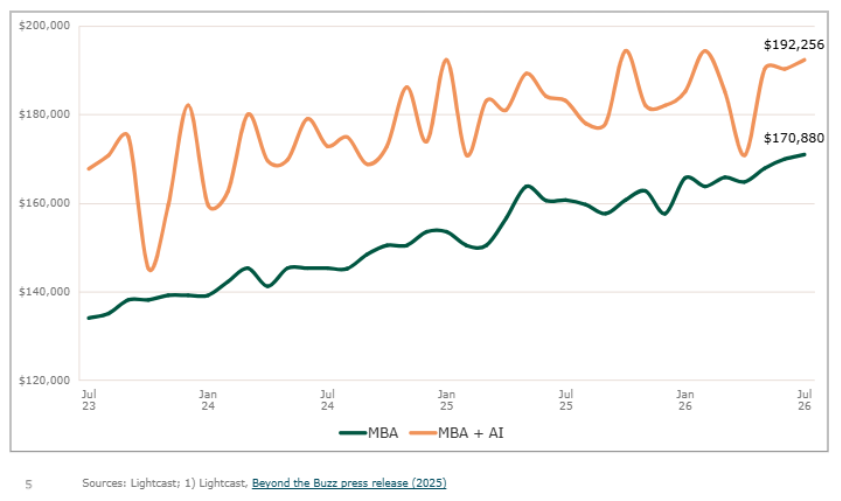
AI skills now carry a measurable salary premium. For MBA job postings that request AI skills, there is an observed premium of a 28% average salary advantage, nearly $18,000 advertised in a market-wide analysis for MBA-related roles.
How the workforce is changing
AI’s impact on the workforce is landing hardest in specific industries, reshaping how traditional business skillsets are defined and sought after with prospective hires. This recalibration is most visible in roles tied to the Master of Business Administrations (MBA). This distinction matters for how higher education institutions offering MBA programs respond, as the gap widens between what employers are asking for and the skills MBA graduates are prepared to offer.
Tomorrow’s standout MBA graduate will not merely use AI, they will know where it should be used, how to measure its value, and how to govern the process. Job posting data spanning July 2023 to July 2026 shows that AI skills have gone from niche to mainstream across MBA roles. Now, nearly a third (~30%) of MBA-related job postings have increased the number of AI-related skills listed for preferred candidate qualifications. The AI demand is becoming a substantial layer of MBA hiring.
Here are examples of how the signal may translate into work; they are not rankings of demand by industry.
| Business area | Where the signal may show up | Roles that may be impacted | Capabilities to emphasize |
|---|---|---|---|
| Banking, accounting, and payments | Using AI to support analysis, reporting, controls, and process automation | Finance, accounting, operations, and compliance professionals | Data analysis, governance, workflow management, continuous improvement |
| Pharmaceutical and health-related business | Using AI in data-rich workflows that require oversight and coordination | Product, program, commercial, and operations leaders | Governance, data analysis, cross-functional leadership, workflow management |
| Technology and digital products | Embedding AI in products and scaling AI-enabled operations | Product, program, and operations leaders | Product management, scalability, automation, data analysis |
| Retail and consulting | AI for improving customer insight, recommendations, service delivery, and operating processes | Consultants, general managers, and marketing or operations professionals | Automation, influencing without authority, operational excellence, governance |
Why this matters for learners
For learners questioning whether AI skills are worth the time to learn, the workforce has answered by consistently paying more for hires with AI skills and continue doing so in greater volume year over year. The labor market has added a +15% median premium for existing MBA leadership roles and careers with the mention of AI skills in the job requirements.
The salary premium is visible in roles like Product Manager, Chief Information Officer, and Analytics Manager, but is also obtainable within the career paths most MBA students already have in mind. MBA graduates don’t have to abandon their intended career paths to leverage the value of an AI skillset.
Skills in finance, accounting, strategy, communication, and project execution remain part of the foundation of business degrees. However, MBA graduates who can combine this foundation while managing responsible, AI-enabled decisions will have greater career mobility than the traditional MBA graduate.
Here is a comparison of the top ten emerging roles between traditional MBA and MBA + AI, based on unique job postings July 2025 – July 2026.
MBA occupations
- Business development / sales mgr. (61,271)
- Product manager (55,691)
- Marketing manager (54,255)
- Treasurer / Controller (49,144)
- Financial manager (46,771)
- Financial analyst (37,258)
- Operations manager (31,680)
- Business / management analyst (31,335)
- Corporate development (31,090)
- General manager (25,905)
MBA + AI occupations
- Product manager (12,027)
- Marketing manager (5,294)
- Business development / sales mgr. (4,591)
- Business / management analyst (3,557)
- Operations manager (3,221)
- AI engineer (3,204)
- General manager (2,881)
- Financial manager (2,782)
- Chief Information Officer (2,664)
- Engineering manager (2,483)
Ways to apply this signal
Programs taking stock of their MBA curriculum and deciding what AI should mean for their learners have several options to expose learners to relevant AI skills. Closing the gap between employer demand and graduate readiness requires a series of smaller decisions made across multiple layers of your program.
Use the ideas below to move from consideration to action.
| If you want to… | Consider trying… |
|---|---|
| Start small | Share a current AI article as an optional reading, giving learners a low-stakes opportunity to see how AI is reshaping the business industry more broadly. |
| Update an activity | Turn an existing mock interview or career preparation activity into a salary negotiation exercise where students signal their AI fluency within a specific job function. |
| Strengthen assessment | Add a short reflection component to an existing case study asking learners to identify how AI adoption could have changed the business outcome and why. |
| Revise a course | Rebuild one module around a real-world scenario where a company in a traditional industry utilizes AI within its business model. |
| Revise a program | Write AI fluency directly into one program-level outcome to signal graduates are well-positioned for the growing demand of the workforce. |
Reflection
AI is reshaping how the MBA credential is defined. Rapid AI adoption among employers will continue to change the skill set of an MBA from a “general manager who knows the traditional MBA frameworks” to an “accountable leader who can frame, deploy, and evaluate, and govern AI-enabled decision making for businesses.” Institutions that treat AI as supplemental or elective risk their graduates falling behind an increasing AI dominant labor market.
As you consider what the workforce signal means for your program, use the questions below to turn the trend into a conversation on campus.
- Do our faculty have AI fluency? What training or information do faculty need to better understand the growing AI demand?
- How are we keeping up with the rapid pace at which AI changes? Do our courses treat AI as an elective or add-on? Where can we find opportunities to weave AI fluency through core content instead of a subtopic?
- Are we teaching learners how to use AI tools, or are we teaching judgment of the output? Which existing courses already touch the roles where AI fluency is concentrated, and is that connection explicit enough for learners to articulate to potential employers?
- What does AI fluency mean for our graduates? Do our courses or programs have AI specific language withing the learning outcomes? And is that language written to be relevant for the growing employer demand?