
Beyond technical AI skills, MBA job postings saw the most growth for six in-demand AI skills: automation, scalability, product management, data analysis, workflow management, and governance. Together, these capabilities have formed what Risepoint calls the “AI management stack.”
How the workforce is changing
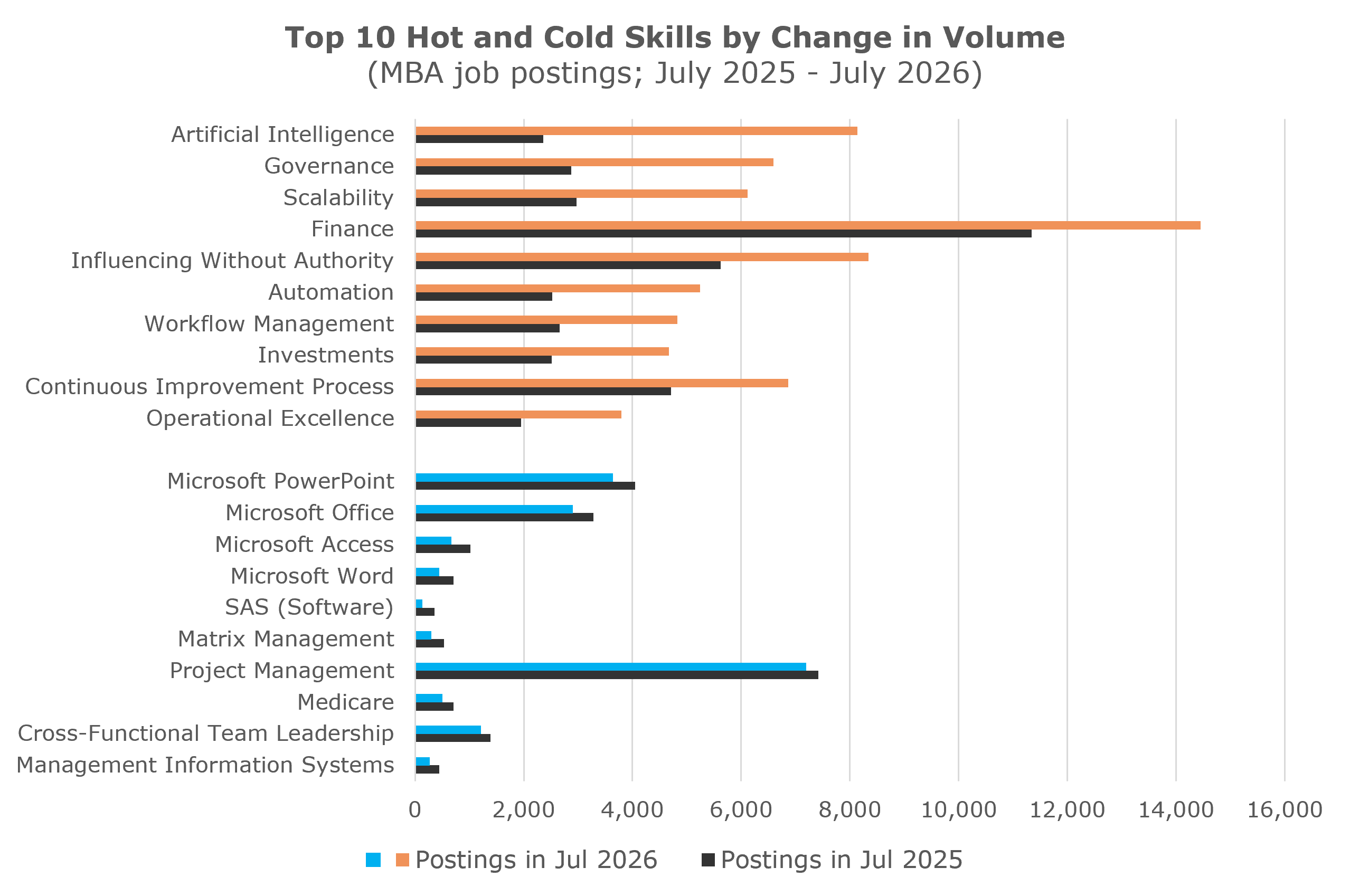
While technology-focused roles continue to demand AI fluency, the business industry is increasing their demand for AI skillsets. Skill growth trends in job postings indicate emerging demand for a new type of MBA graduate. Automation and scalability now appear roughly three times as often in MBA-related job postings, while governance and product management have more than doubled. Employers aren’t inventing new jobs and roles for AI, rather the AI management stack is becoming a competitive requirement for traditional MBA graduates.
Jobs data supports a new type of desirable MBA candidate, and this candidate has an AI skills profile. It’s not enough for graduates to have AI literacy, instead employers are looking for learners to develop AI fluency. The current workforce is demanding graduates be fluent enough to challenge the technology’s outputs, commercially grounded enough to prioritize where it creates value, and accountable enough to govern how it’s implemented.
| Business area | Where the signal may show up | Roles that may be impacted | Capabilities to emphasize |
|---|---|---|---|
| Banking, accounting, and payments | Using AI to support analysis, reporting, controls, and process automation | Finance, accounting, operations, and compliance professionals | Data analysis, governance, workflow management, continuous improvement |
| Pharmaceutical and health-related business | Using AI in data-rich workflows that require oversight and coordination | Product, program, commercial, and operations leaders | Governance, data analysis, cross-functional leadership, workflow management |
| Technology and digital products | Embedding AI in products and scaling AI-enabled operations | Product, program, and operations leaders | Product management, scalability, automation, data analysis |
| Retail and consulting | AI for improving customer insight, recommendations, service delivery, and operating processes | Consultants, general managers, and marketing or operations professionals | Automation, influencing without authority, operational excellence, governance |
These are cross-sector examples of how the signal may translate into work; they are not rankings of demand by industry.
Why this matters for learners
Traditional business skills are losing ground in a market-wide analysis for MBA-related roles. Skills such as Microsoft Office Suite, Matrix Management, Cross-Functional Team Leadership, and Management Information System have declined in frequency over the last year.
The AI management stack gives MBA graduates the credibility needed to make more strategic career decisions. According to Risepoint’s Voice of the Online Learner (2026), career advancement is a primary motivator for online learners. Building a learner’s AI management stack can become a pathway into higher-appeal, higher-compensation roles. Learners who pursue AI skills now have a current advantage over traditional MBA graduates.
Ways to apply this signal
As programs evaluate their existing MBA curriculum and define what AI fluency should mean for their students, a strategic response is to determine where your program’s areas of expertise intersect with the industries where AI demand is growing fastest. There are additional opportunities to expose learners to the emerging AI capabilities in existing activities and courses, and support faculty to apply those decisions.
| If you want to… | Consider trying… |
|---|---|
| Start small | Share a business article in an AI-saturated sector like technology, finance, or pharmaceutical, giving learners an opportunity to explore a new aspect of the industry. |
| Update an activity | Invite a guest expert to speak on how AI management stack is used in the traditional MBA-role daily functions or tasks. |
| Strengthen assessment | Encourage students to use an AI approved tool to generate blind spots, weak assumptions, or missing context to their first draft submission. |
| Revise a course | Establish a course-level AI usage policy that outlines how approved AI tools can and cannot be used in the classroom. |
| Revise a program | Partner with an employer advisory board to incorporate AI management stack across admissions criteria, course design, community building, and career integration to match local employer expectations. |
Reflection
Employers are repeatedly listing automation, scalability, product management, data analysis, workflow management, and governance skills alongside AI capabilities in job postings across the business industry. Institutions serious about graduate employability should integrate the building blocks of the AI management stack in their courses and programs.
As you consider what this workforce signal means for your program, use the questions below to turn the trend into a conversation on your campus.
- Do our program learning outcomes name AI fluency as a distinct, assessable competency, or is it assumed to be picked up elsewhere?
- Do the course learning outcomes tie AI fluency to business judgment rather than tool proficiency?
- Is AI being taught as an isolated technical topic, or integrated into the traditional business framework?
- Are we assessing skills that are cooling in the market?
- How do we measure AI fluency?
- What’s our timeline for responding to this signal and who owns that conversation?
References
About the data. MBA-specific findings and charts are based on Risepoint analysis of Lightcast job-posting data through July 2026. The AI management stack finding comes from Lightcast’s 2025 report, Beyond the Buzz: Developing the AI Skills Employers Actually Need.