
If you are moving a course online, your first instinct might be to record your full lecture and upload it. While this is quick, it often leads to long, passive content that reduces engagement and retention.
Online learning works best when content is shorter, more focused, and interactive. Instead of asking students to sit through a full lecture, you can distill your content and redesign parts of it into activities, discussions, and applied learning experiences.
Follow these steps to optimize your lecture content.
Start by reviewing your original lecture and separating what students must hear from you versus what students could explore, practice, or apply on their own. Then, only keep the most essential explanations as video. Everything else can be redesigned.
A helpful approach is to look for moments in your lecture where you:
- Ask students questions
- Pause for reflection
- Demonstrate something
- Show examples or visuals
In online courses, these moments provide opportunities for interaction and should be redesigned accordingly. If you find yourself thinking, “I have too much content,” focus on learning objectives and remove anything that does not directly support them. (Taylor Institute).
Long lectures increase fatigue and reduce student engagement. Breaking content into shorter segments makes it easier for online students to process and retain information.
Instead of one 45-minute lecture, try 3–5 short videos (3–6 minutes each) where each video focuses on one key concept. Ideally, each video contains a clear title so students can revisit content easily. This allows students to control pacing and revisit specific ideas when needed. If you are worried that “students won’t engage without lectures,” consider replacing lectures with structured activities, not just videos.
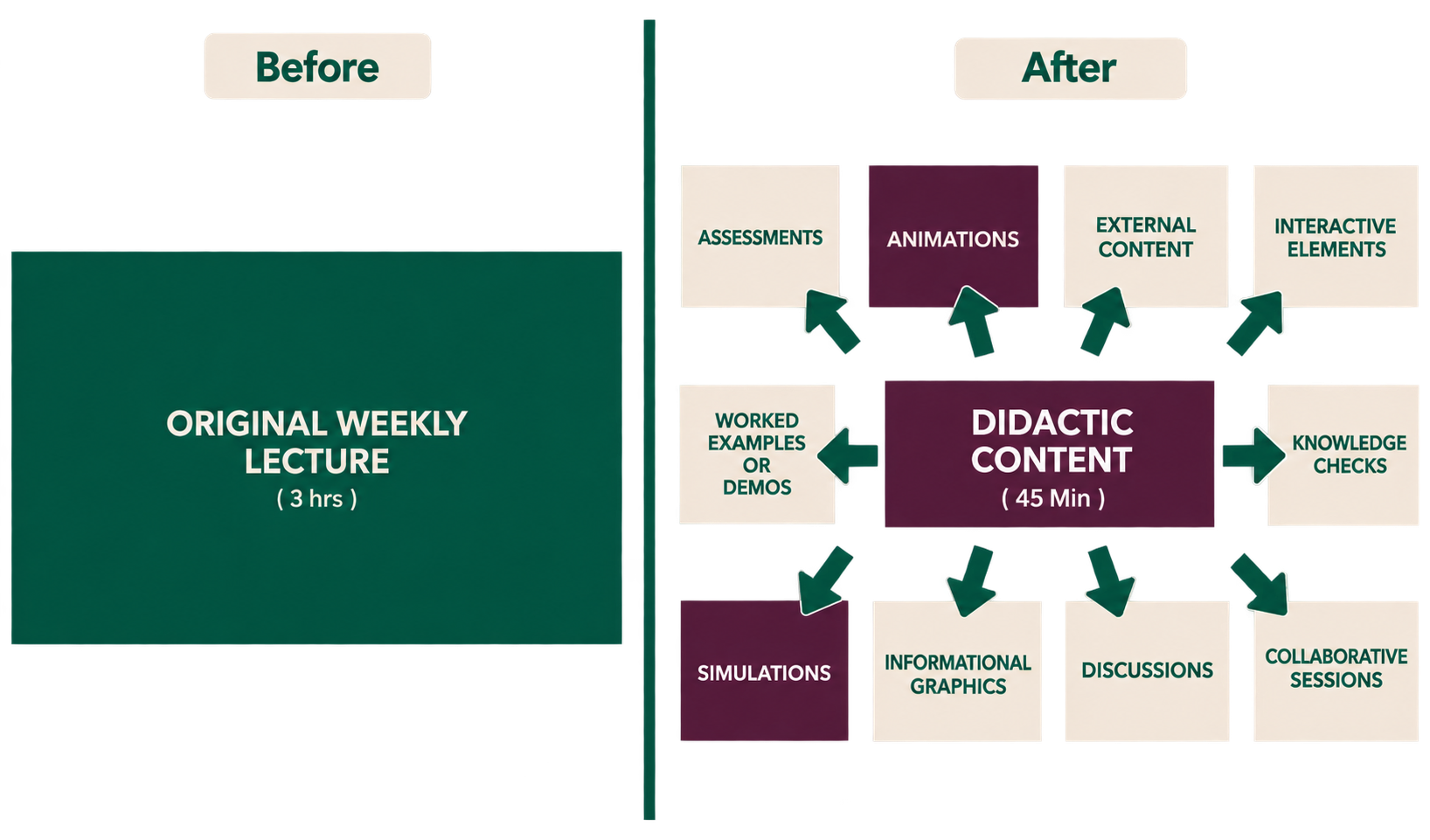
Many parts of your lecture are already interactive; you just need to move that interaction into the course. To do this, ask yourself: “What are students doing during this part of my lecture?”
In a traditional lecture
- You draw a diagram while explaining a concept
- You ask a question and call on students
- You walk through an example step-by-step
- You show a video during class
- You demonstrate a process
In an online course
- Provide the diagram and ask students to label or recreate it
- Turn the question into a discussion or reflection prompt
- Provide a worked example, then ask students to solve a similar problem
- Embed the video with guided questions or a short assignment
- Use a simulation or interactive tool for students to explore
Students benefit from seeing and interacting with content in different ways, not just listening to it.
Instead of thinking in terms of “lecture,” think in terms of a learning flow. A simple structure might look like:
- Brief introduction (text or video)
- Short lecture segment
- Activity or example
- Knowledge check
- Discussion or application
- Assignment
This keeps students moving and engaged throughout the module. If you find that “this takes too much time,” start with one lecture. Break it into 3–4 parts and redesign one interactive element.
You do not need to eliminate lectures. You just need to rethink their role! Keep lectures short and focused, and move everything else into activities where students can apply, practice, and interact. When you do this, your course becomes more engaging, more manageable, and more effective for online learning.