
As you design or revise your online course, take time to estimate your students’ workload. Use the resources below to calculate the time required for course activities and ensure it aligns with federal credit hour expectations.
Student workload calculator
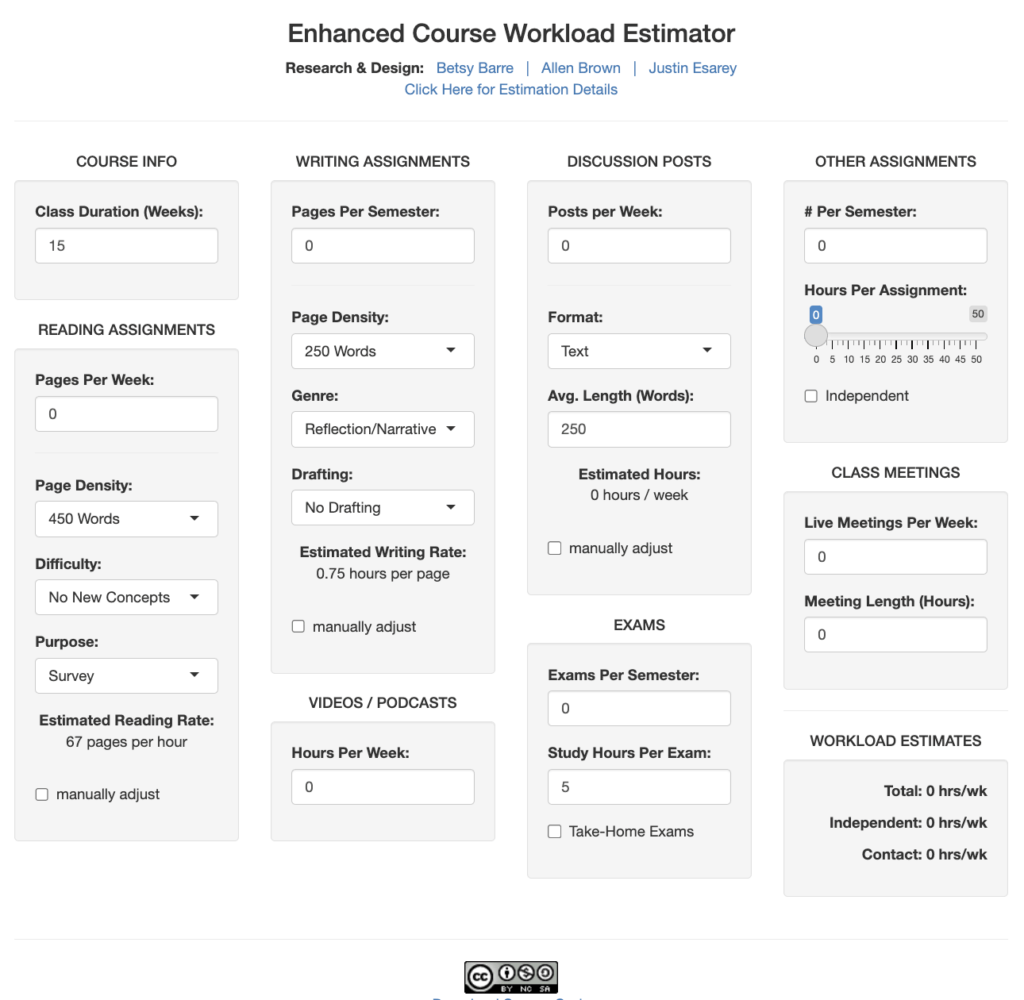
The enhanced Wake Forest University Workload Estimator 2.0 expands upon the original calculator from Rice University, allowing you to estimate reading, writing, video/podcast, discussion, exam, assignment, and class meeting workloads in your courses. Use the calculator to gain a better understanding of workload estimates for your course.
Comparing workload to credit hours
After identifying the current workload hours in your course, compare them to the number of workload hours expected in your course based on credit hour. You can do that by calculating the:
- Total number of workload hours in a course = # of credits x 45 hours
- Number of workload hours per week in a course = total # of workload hours / # of weeks
| Course credit hours | Total workload hours | Weekly workload in hours 15 weeks | Weekly workload in hours 7 weeks |
|---|---|---|---|
| 1 | 45 | 3 | 6.4 |
| 2 | 90 | 6 | 12.9 |
| 3 | 135 | 9 | 19.2 |
| 4 | 180 | 12 | 25.7 |
The federal credit hour
The U.S. Department of Education defines a credit hour as “One hour of classroom or direct faculty instruction and a minimum of two hours of out-of-class student work each week for approximately 15 weeks for one semester or trimester hour of credit, or 10 to 12 weeks for one quarter hour of credit, or the equivalent amount of work over a different amount of time; or at least an equivalent amount of work as required in paragraph (1) of this definition for other academic activities as established by the institution, including laboratory work, internships, practica, studio work, and other academic work leading to the award of credit hours.”