
Email or course messaging is still your most effective communication tool in online courses between you and your students, but impact comes from when and how consistently you use it, not how often.
Research shows that instructor-initiated emails increase students’ sense of support and satisfaction (Heiman, 2008), and regular interaction can improve retention (Jaasma & Koper, 1999). At the same time, more emails don’t necessarily improve the student experience. Strategic timing matters more (Woods, 2002).
What should you do?
- Email your class twice a week, consistently: Consider sending a start-of-week message to set expectations and a midweek message to prompt progress and remind students of deadlines.
- Time emails around when students are active: A 2017 Risepoint study showed that students are most active in the LMS right before due dates, and they are often active in the evenings (Table 1). For your course, aim to send messages 4–6 hours before deadlines, so students are more likely to see and act on them.
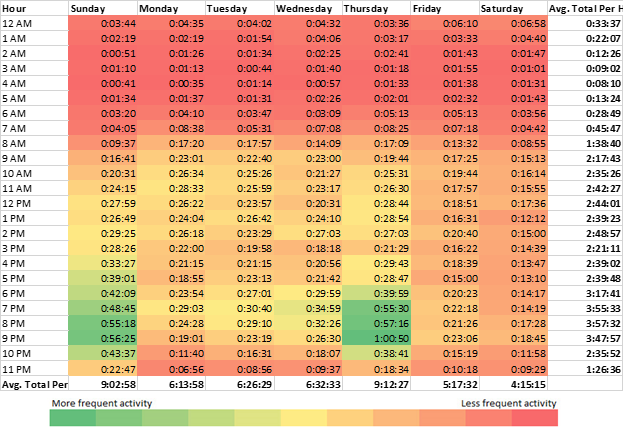
- Align your communication to your course schedule: Using your LMS analytics, explore when your students log in most and try aligning your communication schedule to their activity. For example, if you consider the analytics information in the table above, because activity peaks on Thursday and Sunday evenings, these could be strong windows for reminder emails or deadline nudges.
- Respond within 24 hours on weekdays: Most students expect timely replies, and responsiveness reinforces your presence in the course (Chang et al., 2016).
You don’t necessarily need to email more, you just need to email at the right moments. A predictable cadence, aligned to deadlines and student activity, helps you stay present and effective without increasing your workload.
References
- Argon, S. (2003). Creating social presence in online environments. New Directions for Adult and Continuing Education, 100, 57–68.
- Boettcher, J. V. (1998). How many students are “just right” in a web course? Syllabus, 12(1), 45–49.
- Chang, C., Hurst, B., & McLean, A. (2016). How fast is fast enough? Education students’ perceptions of email response time in online courses. Journal of Educational Technology Development and Exchange, 9(1), 1–11.
- Floral, P. A., Turner, P. D., Monaghan, M. S., Walters, R. W., Merkel, J. J., Lipschultz, J. H., & Lenz, L. L. (2010). Faculty and student expectations and perceptions of e-mail communication in a campus and distance doctor of pharmacy program. American Journal of Pharmaceutical Education, 74(10), 1–11.
- Heiman, T. (2008). The effects of email messages in a distance learning university on perceived academic and social support, academic satisfaction, and coping. The Quarterly Review of Distance Education, 9, 237–248.
- Jaasma, M. A., & Koper, R. J. (1999). The relationship of student-faculty out-of-class communication to instructor immediacy and trust and to student motivation. Communication Education, 48(1), 41–47.
- Rourke, L., Anderson, T., Garrison, D., & Archer, W. (1999). Assessing social presence in asynchronous text-based computer conferencing. Journal of Distance Education, 14(2).
- Woods, R. H. (2002). How much communication is enough in online courses? International Journal of Instructional Media, 29(4), 377–394.