
When you design assessments in an online course, large, high-stakes assignments can create challenges for both you and your students. Students may feel overwhelmed, fall behind, or struggle to apply feedback. You may find it difficult to provide timely, meaningful feedback on complex work.
Scaffolding offers a practical solution. By breaking a large assessment into smaller, connected steps, you give students opportunities to practice, receive feedback, and improve before submitting their final work. This approach supports deeper learning, reduces cognitive overload, and improves student performance (Ambrose et al., 2010).
What is scaffolding?
Scaffolding is the process of structuring an assignment into smaller tasks that build toward a final product. Each step is intentional and prepares students for the next stage.
Instead of asking students to complete a full project at once, you guide them through the process. Helping students build skills over time, manage their workload more effectively, and apply feedback more frequently.
When should you scaffold an assessment?
Consider scaffolding when an assignment:
- Requires multiple skills or steps
- Uses unfamiliar tools or technology
- Has a high impact on the final grade
- Takes more than one week to complete
If students need time to plan, practice, and revise, scaffolding will improve both the learning experience and the final outcome.
How to scaffold an assessment?
The process of scaffolding is not one size fits all. The structure, number of steps, and types of activities you use should align with your course goals, the complexity of the assignment, and your students’ needs. Try one of these strategies to break down a large assignment into manageable parts.
Provide grading criteria and examples early so students understand what success looks like.
Example
In a research paper assignment, you share the rubric and a sample paper in week 1 so students can see expectations before they begin.
Give students opportunities to practice key skills before they are graded on the full assignment.
Example
Before a final virtual presentation, students submit a short video introduction to practice recording, using the software, and receive feedback on delivery and clarity.
Divide the assessment into smaller submissions that build toward the final product.
Example
Instead of one final paper, students submit:
- Topic proposal
- Annotated bibliography
- Draft introduction
- Full draft
Use peer review to help students learn from each other and refine their work.
Example
Students exchange drafts and provide feedback using a rubric, focusing on strengths and one area for improvement.
Feedback is most effective when students can apply it to future work. Plan grading timelines so students can revise before the final submission (Hattie & Timperley, 2007).
Example
You provide feedback on a draft within a few days so students can incorporate changes into their final submission.
Give students structured opportunities to improve their work based on feedback.
Example
Students revise their draft after peer and instructor feedback and can optionally submit a second draft for additional input.
Why scaffolding improves engagement?
Scaffolding keeps students actively involved throughout the course instead of concentrating effort at the end. Students are more likely to succeed when they can practice, reflect, and improve over time.
It also:
- Reduces anxiety around high-stakes assignments
- Encourages continuous progress
- Strengthens instructor presence through feedback
- Supports deeper learning through revision
Example of scaffolding a final project
Scaffolding transforms large assessments into a guided learning process. When you break assignments into stages, provide feedback along the way, and create opportunities for revision, you help students stay engaged and produce stronger work.
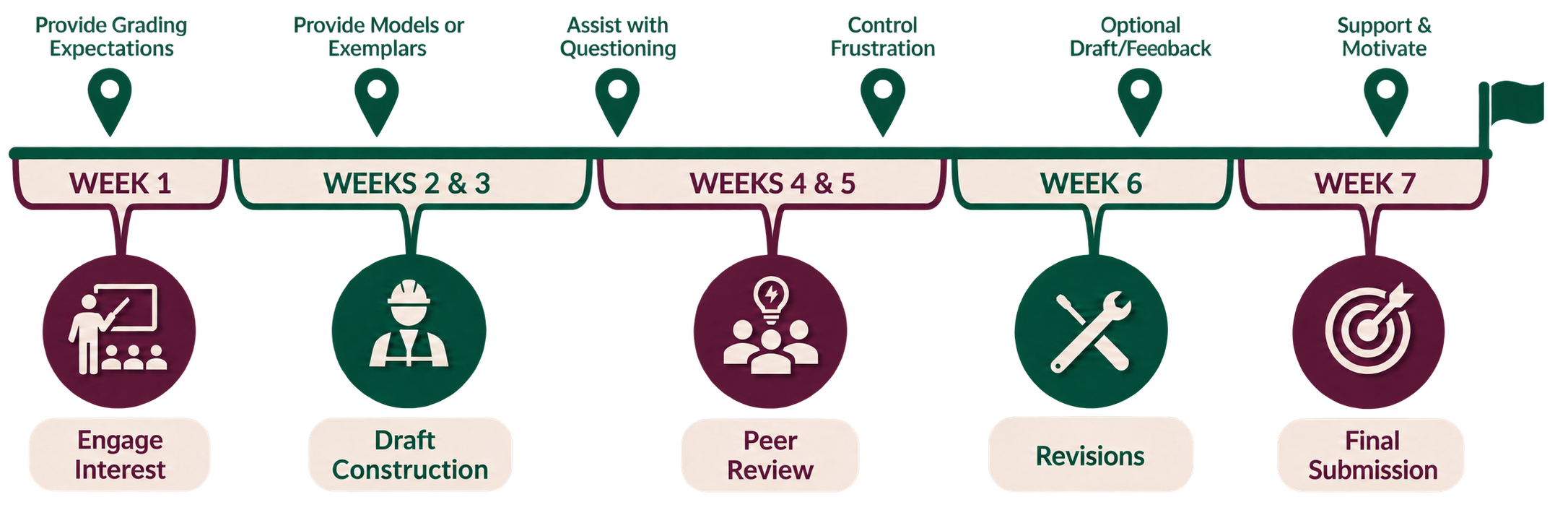
The example below shows how a large assessment can be structured across a seven-week course.
- Week 1: Introduce assignment and expectations
- Weeks 2–3: Provide examples and begin drafting
- Weeks 4–5: Peer review and instructor feedback
- Week 6: Revision and optional draft submission
- Week 7: Final submission
This approach increases feedback opportunities, builds student confidence, and improves the quality of final work.
References
- Ambrose, S. A., Bridges, M. W., DiPietro, M., Lovett, M. C., & Norman, M. K. (2010). How learning works: Seven research-based principles for smart teaching. Jossey-Bass.
- Hattie, J., & Timperley, H. (2007). The power of feedback. Review of Educational Research, 77(1), 81–112.