
Before you complete a module design, don’t forget to ask: “How long will this actually take a student to complete?” Time on task is the total amount of time your students spend actively engaging with your course each week. This includes both:
- Direct instruction: when you are actively guiding learning (your videos, announcements, feedback, live sessions, or facilitated discussions)
- Indirect instruction: when students are applying what they’ve learned (readings, assignments, discussions, projects, etc.)
But time on task isn’t just a definition. It’s a design tool you can use to make better decisions about your course.
How much time should your students spend on your course?
Using the equation below, you can help determine how much time your students, in general, should be spending per week on your course. A common benchmark is ~3 hours per week per credit hour (Carnegie Foundation). While many institutions use this benchmark, your program or modality may define workload expectations differently.
(Course credit hours × 45) ÷ 7 = Weekly hours (7-week course)
This is your weekly hours target for student work. If the weekly workload of your course consistently exceeds this, your students may feel overwhelmed. If it falls short, they may not be engaging deeply enough. Before you finalize a week or a module of a course, ask yourself: “Could a student realistically complete this week’s work in the expected number of hours?”
How are your students spending that time?
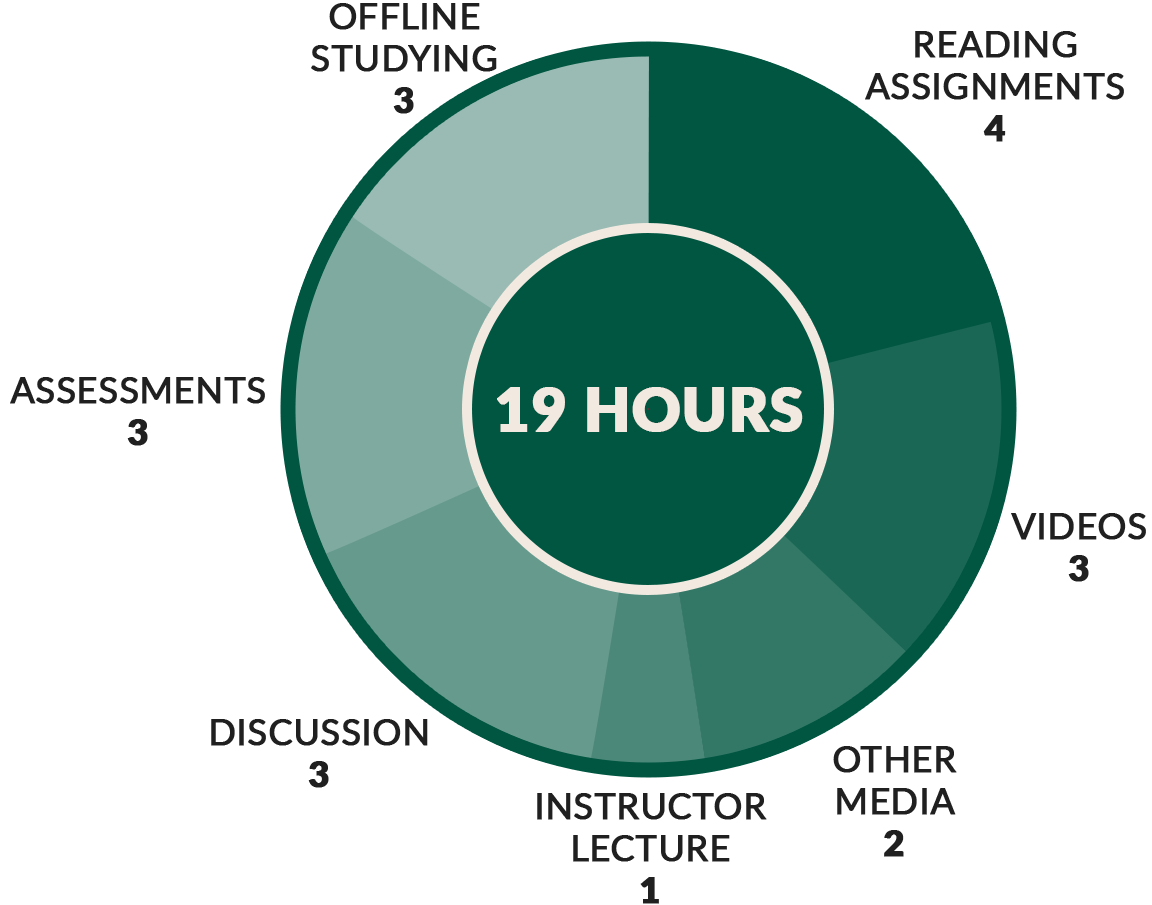
Start by selecting one of the weeks or modules in your course. Review all of the activities in the course, reflect on how long you estimate each activity to take, and note that time. For example, in a 7-week, 3-credit hour course (~19 hours/week), your breakdown might look something like this:
Once you’ve mapped out time and compared it to the amount of time students should spend in your course, you can start making adjustments:
- If one assignment takes up most of the week: Consider breaking it into smaller parts or spreading it across multiple weeks
- If everything feels time-intensive: Explore adding lower-stakes or lighter activities to create balance
- If there is a lot of content for students to explore: Identify opportunities to change required materials to supplementary
- If students struggle with time management: Communicate with them how long each task should take
- If engagement is low: Shift more time toward interactive or applied activities where you feel they are appropriate
References
- Carnegie Foundation for the Advancement of Teaching. What is the Carnegie Unit? https://www.carnegiefoundation.org/what-is-the-carnegie-unit/