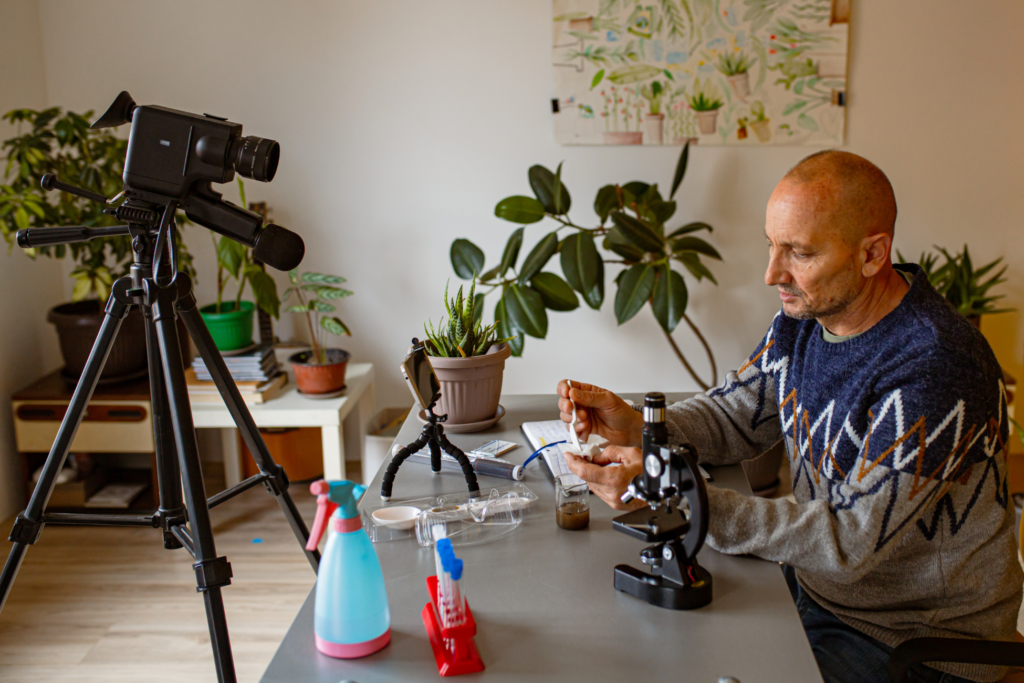
Practical experiences help students make sense of abstract concepts in STEM courses. In an online environment, you can still offer meaningful lab experiences, but you need to be intentional about how you design and deliver them. The goal is not to replicate a physical lab exactly. The goal is to help students observe, test, analyze, and apply scientific ideas in ways that are feasible and safe.
Review a few of the opportunities to provide successful and engaging online labs below.
Design simple, safe at-home labs
For introductory courses, you can consider creating lab activities that students complete at home using common materials. These labs should emphasize observation, measurement, and analysis rather than complex procedures.
Details
To ensure success, at-home labs should include step-by-step directions for each experiment (e.g., via instructional videos or detailed, illustrated handouts) and require students to submit a lab report that details their findings. Focus on what students do with the results. Ask them to interpret data, explain outcomes, and connect findings to course concepts. A well-designed at-home lab is less about precision and more about thinking like a researcher.
Use simulations to model complex or unsafe experiments
Some experiments are too dangerous, expensive, or time-intensive to replicate at home. In these cases, simulations are a strong alternative. They allow students to manipulate variables, run multiple trials, and see immediate results.
Details
For example, PhET Interactive Solutions at the University of Colorado-Boulder provides free interactive science simulations for topics such as physics, chemistry, biology, and more. PhET simulations use gamification to engage students. They’re available for all grade levels—from elementary to university students and across all platforms and devices.
Use video to explore scientific thinking
As an alternative to asking students to perform or replicate an experiment, you can consider redesigning the lab to focus on reflection. In this model, you create a video in which you perform the experiment and then post that video to the course.
Details
Ask students to “participate” by:
- Pausing the video at key moments and asking them to predict what will happen next
- Providing a data set from the experiment for analysis
- Asking students to explain why the results occurred using course concepts
Consider lab kits when you need consistency
Another way to incorporate authentic lab experiences into an online course is to work with companies that will ship science kits to your online students.
Details
Explore these options:
- Science Interactive has collaborated with more than 300 colleges and universities to provide online students with authentic lab experiences in physics, anatomy and physiology, forensics, and more. Instructors can request an online demonstration and even try out a sample kit.
- Carolina Distance Learning® provides science lab kits for college-level distance education. They also offer a library of free curated resources. Online instructors can request a free sample investigation kit.
Use local or partner labs for high-level courses
If your course requires specialized equipment or supervised practice, consider separating the lecture and lab. You can teach the lecture online and require students to complete the lab in person at an approved location. Exploring options like these are best for higher level courses because on-campus labs typically align better with professional and academic requirements.
Details
If your university has a system for educational reciprocity, there may be solutions already in place:
- Campus labs for local students: Offer the three-credit-hour portion of a course online and require local students to take the one-credit-hour lab portion of the course onsite at your institution.
- Campus labs for long distance students: Your institution may have partner (or affiliate) institutions that offer or host one-credit-hour lab courses that students need. This option works best when your institution is already in a reciprocal agreement with other institutions.
You do not need a physical lab to create meaningful scientific learning. You need clear outcomes, thoughtful design, and activities that require students to think, not just follow steps. When you focus on what students should understand and be able to do, you can choose the lab approach that best supports those goals in an online environment.